
Cats in Japanese woodblock prints are full of curiosity, charm, and quiet mischief. Every cat owner knows the pose: the low crouch, the fixed stare, the tail that betrays everything.
A century ago in Japan, a printmaker named Ohara Koson knew it too — and he carved it into paper so precisely that his cats still feel alive today.
In this article, we look at what cats mean in Japanese art, and read two of Koson’s most charming cat prints closely.
What Cats in Japanese Woodblock Prints Mean
Cats occupy a special place in the Japanese imagination. They arrived centuries ago as guardians of temple scriptures and silkworm farms — practical mousers first, beloved companions soon after. By the Edo period, cats had thoroughly conquered Japanese art: they curl through ukiyo-e prints, lounge beside courtesans, and occasionally star in entire comic scenes of their own.
Unlike the crane or the koi, the cat carries no single fixed meaning. Instead it embodies a bundle of familiar virtues: curiosity, independence, watchfulness, and the quiet good fortune of a contented home. The beckoning cat (maneki-neko) that waves from shop windows across Japan belongs to this same tradition — the cat as a small, everyday bringer of luck.
What makes cats irresistible to artists, though, is simpler: they are pure character. A cat cannot pose. It can only be caught.
The Artist Behind the Cats
Ohara Koson (1877–1945) was one of Japan’s great masters of kachō-e — bird-and-flower prints — working from the late Meiji era into early Shōwa. He is best known for herons, owls, and sparrows rendered with a naturalist’s eye, but his animal prints reveal something else: a sense of humor. Koson’s cats are observed with the same delicacy as his birds, yet they carry personality — tension, mischief, anticipation — that turns each print into a tiny story. His work traveled widely to homes and collectors abroad, where it remains beloved today.
Two Cat Prints, Read Closely
Cat and Butterfly among Violets
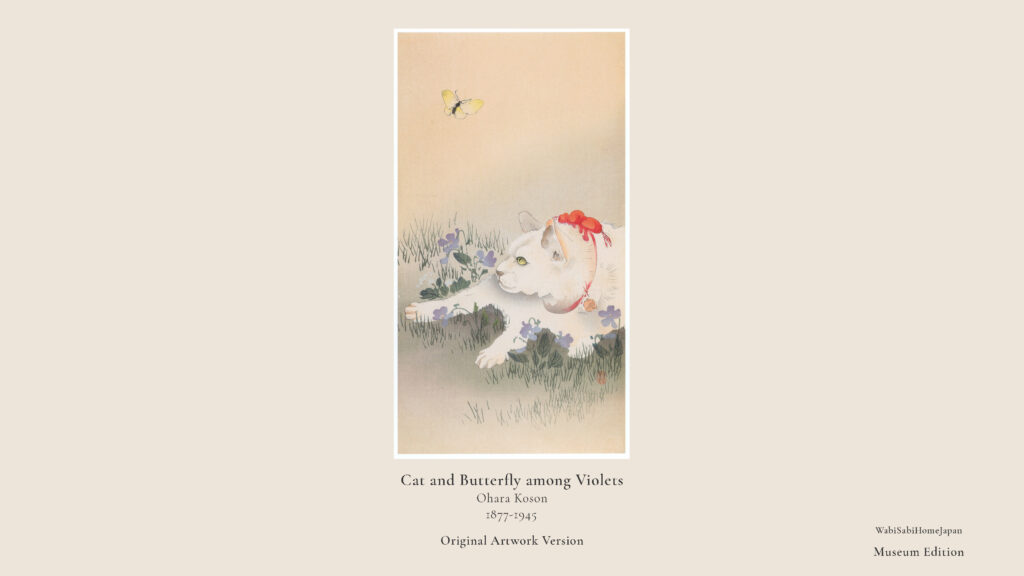
A white cat pauses among spring violets, eyes lifted toward a passing butterfly. Nothing happens — and that is the point. The butterfly brings lightness and fleeting beauty, the violets add tender charm, and the cat holds the whole scene together with silent attention. It is spring distilled into a single watchful moment. A print of this design is held by the Smithsonian’s National Museum of Asian Art as part of the Robert O. Muller Collection — a quiet testament to how far Koson’s cats traveled.
Cat and Lantern
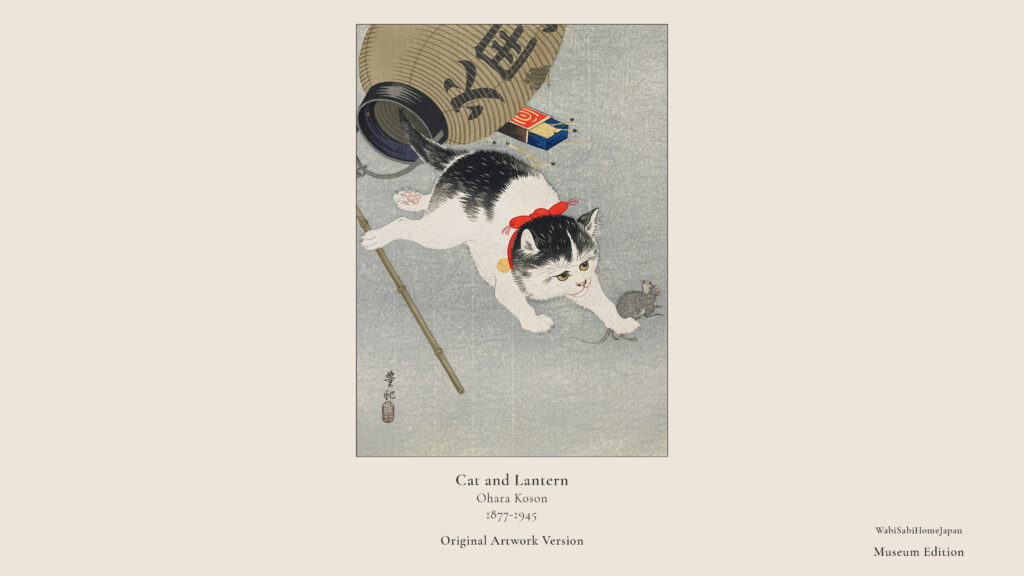
Here the stillness breaks into comedy. A black-and-white cat springs after a tiny mouse beside a fallen paper lantern. The pose is instantly familiar to any cat owner, while the bold contrast of black, white, and red gives the small drama real graphic punch. It is suspense and amusement in one frame — proof that Koson could be witty without ever losing his elegance.
Living With Cat Art
Koson’s cat prints make natural year-round companions, each with its own seasonal mood: Violets feels at home in spring, while Lantern especially suits autumn. Their soft palettes — ivory, sage, charcoal, and touches of vivid red — sit comfortably in Japandi, Wabi-Sabi, and Scandinavian interiors.
On a Samsung Frame TV, start with the No Mat version for a clean, gallery-like look, or choose a warm white or ivory mat for a softer feel. Paired across the seasons, the two prints bring a cat on duty from spring into autumn.
Together, these cats in Japanese woodblock prints bring humor, seasonality, and quiet character into the home.
Explore the Collection
Both prints are available as high-resolution Frame TV art downloads from WabiSabiHomeJapan on Etsy. Each download includes an Art Story Guide.
Explore more stories about symbolism, seasons, and everyday life in our Japanese Art Stories collection.